| |
 |
| Hudhufushi - Dhiffushimaadhoo Area Should be Declared as Nature Reserve |
 |
| During the last few years, we have been witnessing a rapid human encroachment on the terrestrial vegetation, reef and wetland ecosystems of uninhabited islands and inhabited islands in the Maldives... read more |
| |
| When Groundwater Turns Deadly |
 |
| The sad deaths of five young men in a well in Malé Fish Market on 3 March 2008 (Youth Day in the Maldives) shocked the people of the Maldives... read more |
| |
| Towards an Artificial Paradise on Earth |
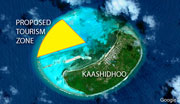 |
| The Government has recently announced plans to develop ten artificial islands by reclaiming natural lagoons of inhabited islands... read more |
| |
|
|
|
| |
Environment
News, Articles and Reports
| Floating Dead Giant Squid Found in Maldives |
| Bluepeace, 2008 |
|
Photo released by Marine Research Centre, Maldives
|
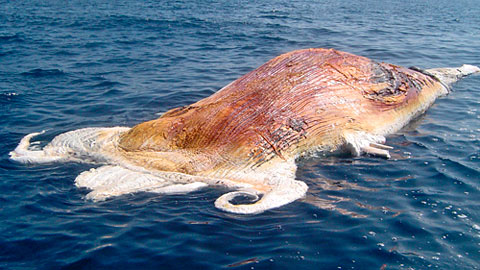
| A dead giant squid, which measured about 25 feet long was found floating in the waters of Haa Alifu Atoll near Maafahi Island in the Maldives on 20 January 2008. According to the Marine Research Centre, the squid was badly decomposed and possibly dead before it had floated into the Maldivian waters. The dead giant was not brought to shore and left floating in fear of possible spread disease. |
| |
| According to the Institute of Antarctic and Southern Ocean Studies, squids grow exceptionally fast and keep growing until they die. The life expectantsy of giant squid is probably at about three years. They stuff a lot into their short life, eating and mating wherever and whenever possible. Squid eats anything that comes their way, even other squid. For sperm whales, giant squid are major source of food. |
| |
Base on pieces of carcasses found in the bellies of sperm whales, giant squid can range up to one hundred feet. Sperm whale excrete ambergris, a pracious waxy substance found by the natives of the Maldives for centuries on the shores or floating contain beaks of squid after they eat on squid know as “goma niyafathi” (poop nail). |
| |
One unconfirmed story as reported by a sailor on a British Admiralty trawler lying off the Maldive Islands in the Indian Ocean during World War II, though, suggests they might get even larger. One of the crew, A. G. Starkey, was up on deck, alone, fishing, when he saw something in the water: |
| |
"As I gazed, fascinated, a circle of green light glowed in my area of illumination. This green unwinking orb I suddenly realized was an eye. The surface of the water undulated with some strange disturbance. Gradually I realized that I was gazing at almost point-black range at a huge squid." |
| |
| Starkey realized it was huge squid. He walked the length of the ship calculating tail to tip at one end and the tentacles at the other. The ship was over 175 feet long. |
| |
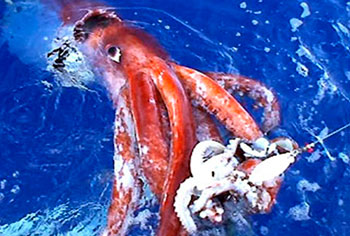
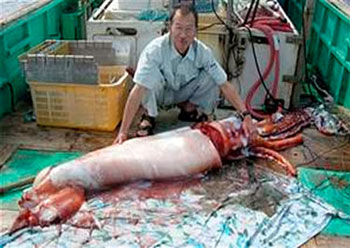
| For the first time, on 4 December 2006, the Japanese research team, led by Tsunemi Kubodera with Japan's National Science Museum have captured giant squid on film, measured about 24 feet long off Orgasawara Islands (south of Tokyo), and the squid died while being captured. |
| |
|
| |
 |
Photos released by Tsunemi Kubodera, a researcher with Japan's National Science Museum |
|
| |
|
|